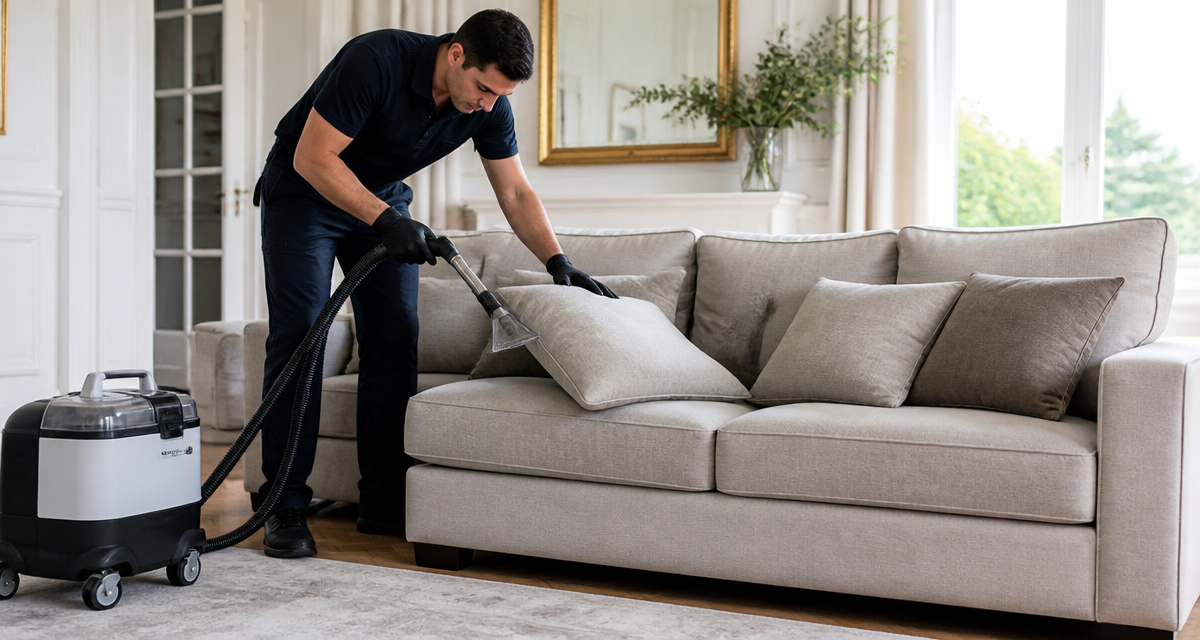
Acting quickly on a fresh stain, understanding why some odours come back and knowing when a professional treatment really helps: field notes from Pronett67 in Strasbourg, without miracle promises.
A stain on a sofa, mattress or rug is rarely just a visual accident. Depending on the liquid, the fabric and how long it has been there, it may have soaked into the foam, worked into the weave or altered the fibre itself.
A persistent smell in a sofa is not fixed with a fragrance. Identify the source, air the room, remove debris, avoid risky mixtures — and treat the cause, not just the symptom.
In the first minutes, a fresh stain sits mostly on the surface. The liquid has not yet migrated into the foam and has not dried into the fibre. After a few hours, the water evaporates but the pigments, salts and proteins stay behind and set. That is why a coffee stain forgotten over a weekend behaves very differently from one dealt with within the hour.
On sofas and mattresses, thickness makes it worse: the foam absorbs part of the liquid and slowly releases the residue. A stain that looks gone from the surface can reappear days later as a halo.
Identify the stain before doing anything
The first good reflex is not to clean — it is to look. A biological stain (urine, blood, vomit) is not treated the same way as a food stain (coffee, wine, grease). A product suited to one may permanently set the other.
Biological stains: urine, blood, vomit
These stains contain proteins. Use cold water only — never hot, which coagulates proteins and sets them into the fibre. Old urine often needs an enzyme-based product to break down the ammonia salts responsible for the smell.
Coffee, tea, red wine and food stains
These are mostly pigment stains. A quick blot with a white absorbent cloth already helps a lot. On a light-coloured sofa, avoid off-the-shelf stain removers without a discreet test: watermarks are a real risk.
Grease, oil and cosmetics
These stains need a solvent suited to the fabric. A slightly damp microfibre cloth and a mild soap sometimes handle a recent mark, but on delicate fabrics DIY can dull the treated area.
Odours: why they come back
An odour that 'returns' is almost never a bad clean — it is a deeper contamination. Urine soaks into the foam, tobacco clings to fibres and covers, cooking oils build up on fabrics over the months. A spray deodoriser masks; it does not treat. Extraction cleaning removes embedded molecules and neutralises much of the odour — without guaranteeing full elimination on the oldest cases.
Watermarks and rings after DIY cleaning
Most watermarks appear when a fabric dries unevenly, or when a household product leaves a lighter residue as it dries. On microfibre in particular, this can create a visible ring far larger than the original stain.
Never mix bleach, ammonia, vinegar and hydrogen peroxide. These combinations can release dangerous fumes and irreversibly damage the fabric.
Do not rub a fresh stain — you spread it and damage the fibre.
Never use hot water on a biological stain.
Do not saturate the fabric with water — foam holds it for a long time.
Avoid strong stain removers on delicate fabrics without a discreet test.
A discreet test before any treatment
On delicate fabrics — microfibre, alcantara, wool, viscose — a test on a hidden area is essential. We always do this before intervention, and we recommend doing it at home too, even with a product described as 'gentle'.
Professional Pronett67 intervention in Strasbourg
Diagnosis of the stain and the fabric, taking history into account.
Discreet test on a hidden area.
Targeted pre-treatment matched to the type of stain.
Injection-extraction with a product suited to the fabric.
Drying check and odour neutralisation if needed.
Some stains have permanently altered the fibre or its colour. We are transparent about limits: we would rather announce a realistic partial result than promise a miracle.
Send a photo for a first assessment
Most of our clients in Strasbourg and the Eurométropole send us a photo on WhatsApp. A clear shot in natural light — one wide view and one close-up — usually tells us whether the result will be clean, partial or uncertain. That avoids a pointless visit and lets us send a clear estimate.
Stubborn stain or persistent odour?
Send us a photo on WhatsApp. We reply quickly with an honest first opinion and a clear estimate.
No. Blot it with a white absorbent cloth, working from the edge to the centre. Rubbing spreads the stain and can damage the fibre, especially on microfibre and alcantara.
Can an old stain still be treated?
Often yes, but without full guarantee. The older the stain, the deeper it has migrated. A professional treatment almost always improves the appearance, without promising complete removal.
Why does an odour come back after cleaning?
Because the source is deep — in the foam or padding. Surface cleaning removes the smell temporarily. Extraction cleaning, sometimes with an enzyme product, acts on the source itself.
Can cat urine smell be fully removed from a sofa?
It can be strongly reduced with an appropriate enzyme treatment. On old, repeated urine, total elimination is not always possible — we say so before intervention.
What should I send on WhatsApp for a first assessment?
A wide photo, a close-up of the stain, the fabric type (fabric, microfibre, leather, alcantara), the origin of the stain if known and how long it has been there.
Why can a household product leave a ring?
Because it leaves a residue that dries lighter or darker than the surrounding fabric. On microfibre and alcantara, this is very common with off-the-shelf stain removers.
Is a hidden-area test really necessary?
Yes, on delicate fabrics. It takes two minutes and prevents irreversible damage on fabrics sensitive to water, heat or detergents.