
How to clean a corduroy sofa without damaging the fabric
Crumbs between the ribs, a pale mark on the seat or a spilt drink: how to care for corduroy’s raised texture without improvising a wet treatment.

To clean a corduroy sofa, first read the care instructions for its exact model, then gently remove dust with a suitable upholstery attachment. Blot a fresh spill with a dry white cloth, without rubbing. Water, stain remover, steam, extraction and machine washing are options only if the care instructions allow them. A lighter patch may be caused by the direction of the pile, but that alone does not rule out a stain. After any permitted treatment, wait until the sofa is completely dry before using it again.
Need professional cleaning in Strasbourg?
Send a photo of your sofa, mattress or rug for a first opinion and a clear estimate.
A pale band appears on the seat when you stand up. Crumbs stay trapped in the grooves. You are weighing up a brush, a damp cloth or an upholstery extractor: on a corduroy sofa, each situation calls for a different decision. The raised ribs hold debris, while the pile responds to both light and pressure. Before treating a mark, you need to understand what you are looking at and what the manufacturer allows.
1. Examine the ribs and the mark before cleaning
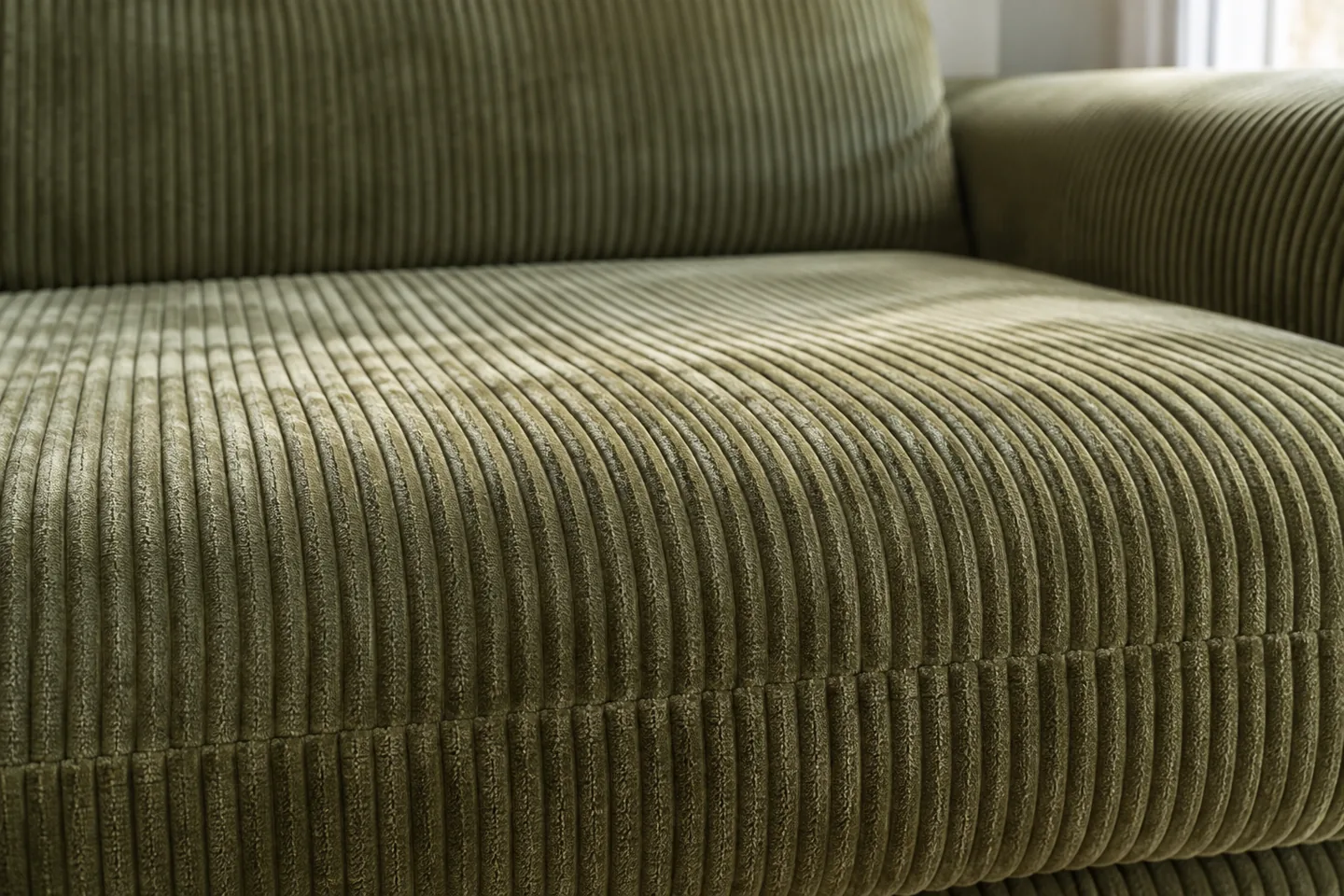
Corduroy is recognisable by its parallel rows of raised ribs. Its appearance alone, however, tells you neither which fibres it contains, how colourfast it is, nor how the cushion is constructed. Two sofas that feel very similar may need different care. The word ‘velvet’ on a product page therefore does not give you permission to wet the fabric.
Look at the mark from several positions without adding any product. A difference in shade that changes with the lighting may be related to the direction of the pile or a compressed area. This does not prove the fabric is clean: dirt, discolouration or wear may also be present. Photographing the same area from two angles helps you describe the problem without risking making it worse.
2. Check the cover’s composition and care instructions
Look for the label beneath the sofa, in its documentation or on the product page for the exact model. Note the composition, the upholstery care instructions and whether the cover is actually removable. A zip may be there for assembly: it does not guarantee that the cover can be removed or machine washed. Do not take a cushion apart simply to find out.
Care instructions illustrate this difference: IKEA publishes care guidance specific to its Samsala cover, while Bemz gives different instructions for its Chunky Corduroy, even though both list recycled polyester. These rules apply to those particular products. For your sofa, also check the seams, linings and filling: the name of a fibre alone does not establish that a treatment is suitable.
3. Remove dust between the ribs without flattening the pile
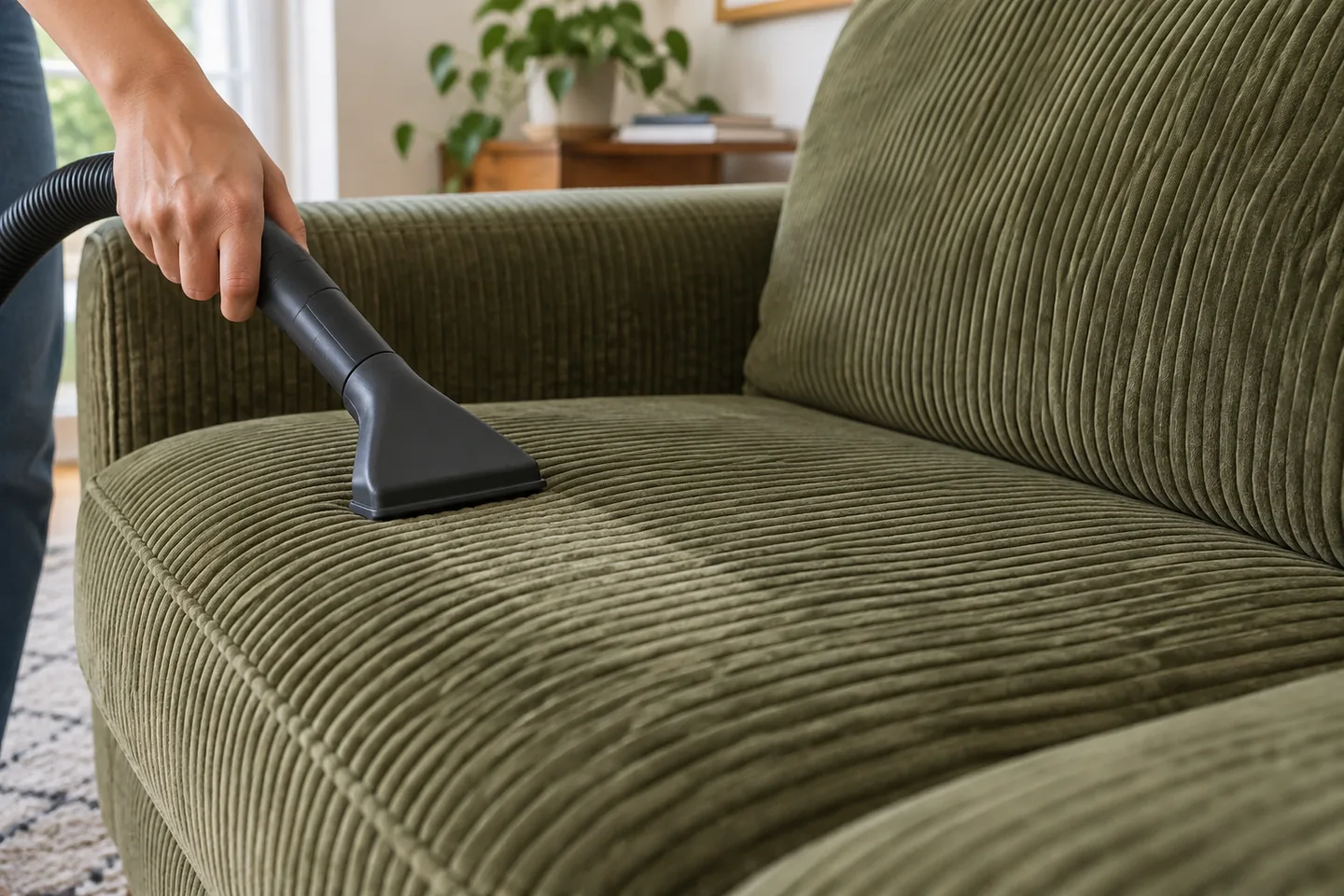
Start with dry debris rather than a spray. Prepare a clean upholstery attachment, check that no rough edge could catch the pile and choose moderate suction. Seams and gaps between cushions need as much attention as the centre of the seat.
- Remove objects from the sofa and any easily accessible crumbs without pushing them into the fabric.
- Move the attachment gently over the surfaces, observing the natural direction of the pile and avoiding firm pressure.
- Use short passes along the grooves, joins and seams. Do not wedge the nozzle between two sections of upholstery.
- Examine the seat again in the light. If a mark remains, identify it before repeating the process or changing methods.
The pile does not necessarily run in the same direction as the ribs. Avoid vigorous back-and-forth movements and stiff brushes. A rotating attachment, a lint roller or a pet grooming brush is no substitute for a recommendation in the care instructions. If fibres catch or visibly shift, stop rather than repeatedly working over the same band.
4. Spilt a drink? Blot first, then decide what to do
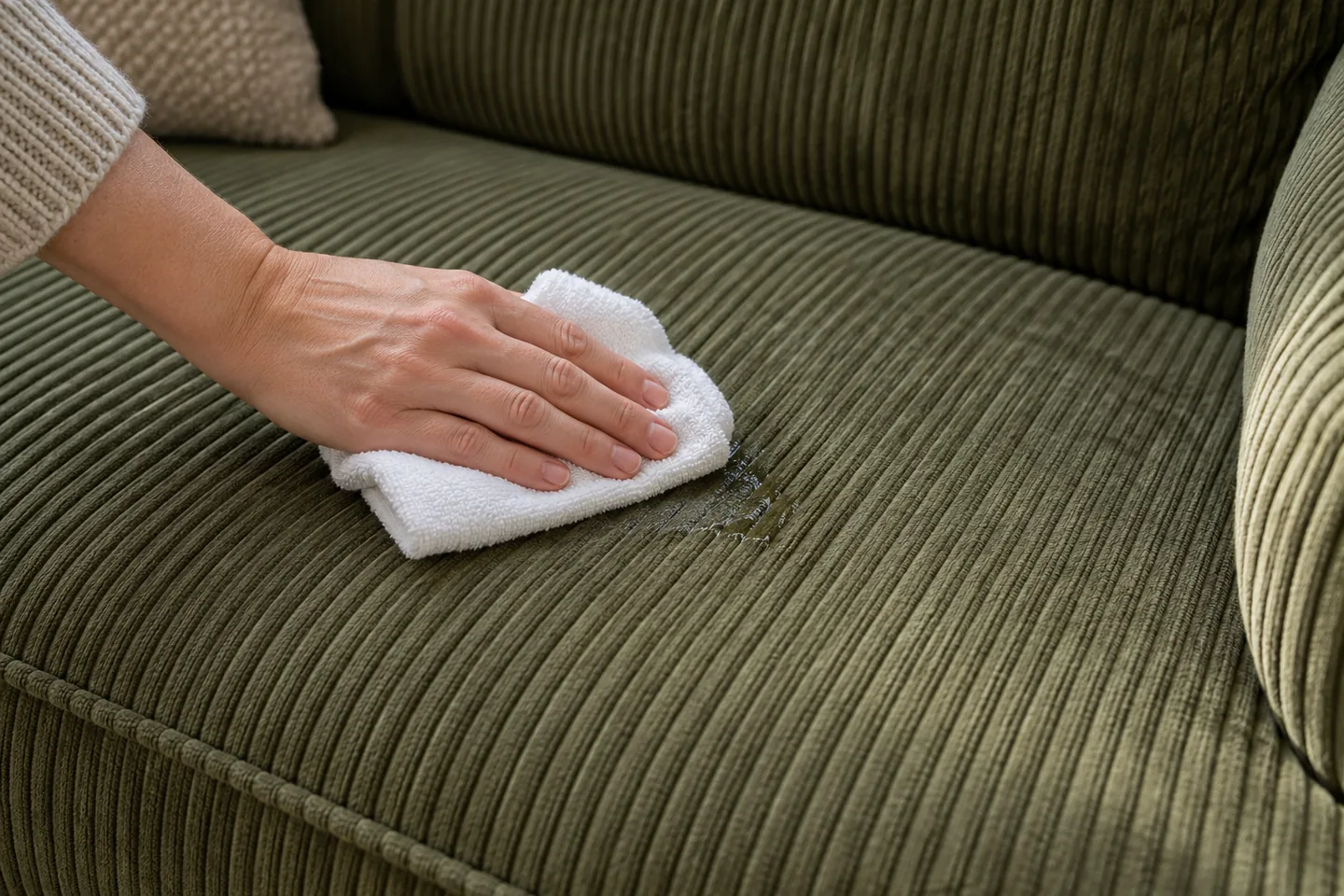
Place a clean, dry, absorbent white cloth over liquid still on the surface. Apply light pressure without sliding the cloth across the ribs. Switch to a dry section of the cloth as it becomes damp. If there is thick food residue, gently lift off the excess with a spoon without pressing it into the pile.
| What you see | First step | What to check next |
|---|---|---|
| Dry dust or crumbs | Gently remove accessible debris. | The condition of the attachment and the vacuuming instructions. |
| A pale band after pressure | Look from several angles without wetting it. | Pile direction, as well as possible wear or a stain. |
| A fresh liquid spill | Blot with a dry white cloth without rubbing. | Whether further spot cleaning is allowed. |
| An old ring mark or a previously treated mark | Take photos and note the products already applied. | The upholstery type and the options for a professional assessment. |
5. For a stubborn stain, follow only the permitted method
If the care instructions allow wet spot cleaning, choose a product compatible with the upholstery and follow its dosage instructions. First carry out the prescribed check on an inconspicuous area, then wait until it is dry before comparing the colour, feel and texture. A darker wet patch alone is not enough to judge the result.
Apply the product as directed, using only the minimum moisture required. If the manufacturer calls for application with a cloth, do not spray it directly onto the fabric instead. Any rinsing or residue removal also depends on the product and the cover. Do not wet the whole seat in the hope of erasing the edge of a small ring mark.
- Stop if colour transfers onto the white cloth.
- Stop if the pile changes texture, comes away or remains visibly marked.
- Do not keep adding different products if the mark spreads or remains after drying.
6. Steam and spray extraction: check both are allowed
A recommendation to remove creases or restore the pile on one particular model does not authorise deep steam cleaning of every sofa. IKEA, Bemz and Kvadrat distinguish between materials and procedures in their guidance; their advice is not interchangeable. Do not use a garment steamer to correct a mark simply because the upholstery is described as corduroy.
A spray-extraction upholstery cleaning machine, which sprays and then vacuums up a cleaning solution, also requires confirmed compatibility with both the fabric and the sofa’s construction. A gentle setting or strong suction does not establish permission to use it. Without clear guidance, do not hire a machine to try it out on the seat. Avoid improvised recipes with vinegar, bicarbonate of soda or washing-up liquid too: their popularity does not prove they are suitable for your cover.
7. Let the sofa dry without heating or covering the ribs
After a permitted wet treatment, let air circulate around the sofa. Space the cushions apart only if their design and care instructions allow it. Do not cover a damp seat with a throw, and arrange somewhere else to sit. A surface that feels dry does not always tell you how much moisture remains beneath it.
There is no single drying time for all corduroy sofas: thickness, the amount of liquid and room conditions all matter. Do not speed up drying with a radiator, hairdryer or iron without explicit instructions. Once the fabric is dry, assess its texture and shade in the same lighting as before; do not automatically apply more stain remover to a shadow that remains.
8. In Strasbourg, prepare the right details for an assessment
A large corduroy sofa, several ring marks or a cleaning attempt that has changed the feel of the fabric warrant an assessment before trying again. Pronett67 provides sofa cleaning in Strasbourg and the surrounding area. The choice of method and the possible result depend on the textile, its condition and previous treatments; a photograph cannot replace every check needed on site.
- Send a photograph of the whole sofa and the number of seats to be cleaned.
- Add photos of the mark from two angles, without filters or lighting that hides the raised texture.
- Photograph the label, composition and cover reference if you have them.
- State what was spilt, how long ago, and every product or appliance already used.
- Professional sofa cleaning in Strasbourg
- The checks and stages involved in professional sofa cleaning
- Send your sofa details to request a quote
Sources and manufacturers’ care instructions
The references below explain differences between products, the effects of pile and care precautions. Instructions specific to Samsala, Chunky Corduroy or another fabric are not universal rules. For your sofa, keep the care instructions for its exact model as your starting point.
What Pronett67 can do
Pronett67 — Strasbourg / Alsace. Sofa cleaning.
Frequently asked questions
Can every corduroy sofa be cleaned with water?
Can a corduroy sofa cover go in the washing machine?
Can you use a steam cleaner on corduroy?
Is a lighter patch on the seat always a stain?
Are bicarbonate of soda or vinegar suitable for this fabric?
How long should you wait before using the sofa again?
Related services
Related articles

Codes W, S, WS and X: how to read a sofa care label
Codes W, S, WS and X appear on many sofa labels, but they don't replace the manufacturer's instructions or a hidden-area test. Here is how to read them safely.

How does professional sofa cleaning work?
Inspection, vacuuming, pre-treatment, injection-extraction, drying: what a professional sofa cleaner actually does, without unrealistic promises.

A second-hand sofa: what to check and how to clean it before use
Before collecting a second-hand sofa: what to ask the seller, which areas to inspect and which care instructions you need to plan suitable cleaning.
Need professional cleaning in Strasbourg?
Send a photo of your sofa, mattress or rug for a first opinion and a clear estimate.