
A second-hand sofa: what to check and how to clean it before use
Before collecting a second-hand sofa: what to ask the seller, which areas to inspect and which care instructions you need to plan suitable cleaning.

To clean a second-hand sofa before use, start by examining it before transport: check its history, stability, seams, accessible underside, signs of damp and care label. If you see insects, suspicious marks or mould, put collection on hold and seek appropriate advice. On furniture with no concerning signs, remove dust with a suitable attachment, then follow the instructions for the exact upholstery. A zip does not prove that a cover is washable. Do not improvise a wet cleaning method when instructions are missing, and wait until the sofa is completely dry before sitting on it.
Need professional cleaning in Strasbourg?
Send a photo of your sofa, mattress or rug for a first opinion and a clear estimate.
The sofa looks clean in the listing, the dimensions fit and the price seems reasonable. Before planning its cleaning, though, there are several things to check: has it been stored somewhere damp, are the cushions sound, and is the cover the original one? The aim is to decide whether this sofa is worth collecting and what care it can actually withstand, rather than assuming every piece of furniture can be made spotless.
1. Before buying: what to ask the seller
Ask for the brand, model and, if possible, the upholstery reference. An old receipt or manual may help you find the care instructions. Treat the seller’s answers as information to check: they complement an examination of the sofa rather than replacing it. A photograph taken from across a room shows neither the underside nor what is tucked inside a seam.
- How has the sofa been used and stored? How long has it been out of use?
- Has there been water damage, persistent damp, exposure to pets or tobacco smoke, or an incident that left a stain?
- Which cleaning methods, stain removers, deodorisers or other treatments have already been used, and when?
- Have the covers or cushions been replaced? Does the label still refer to the upholstery currently fitted?
- Can you examine the sofa and its accessible areas before arranging transport?
Request an overall view and photographs of the arms, seats, seams, accessible underside and care label. Ask the seller to point out any known defects. If the sofa is still damp from recent cleaning, it is too soon to judge the result or how it will smell once dry. Postpone the assessment instead of immediately adding another treatment.
2. Inspect the sofa before arranging transport
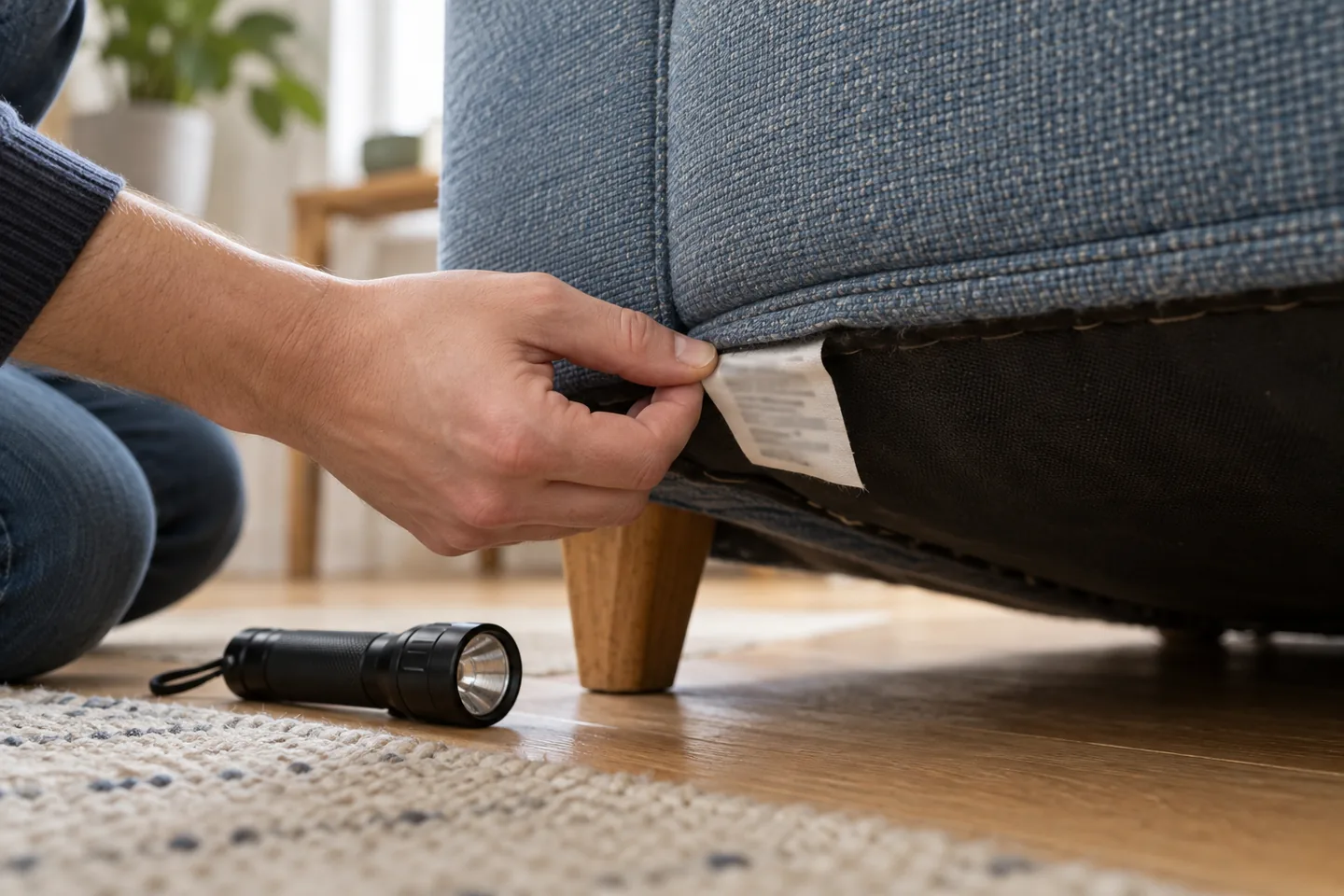
Examine the sofa in sufficient light, with the seller’s permission. Lift only cushions designed to be removed. Do not cut the lining underneath or take apart stapled upholstery. Ask for help to see an inaccessible area; do not tip a heavy sofa over on your own. This checklist helps you observe its condition; it is not a structural safety inspection.
| Area | What to look for | How it affects your decision |
|---|---|---|
| Seats and cushions | Pronounced sagging, uneven foam, torn fabric or open seams. | Allow for possible repairs or replacement; cleaning will not repair the foam. |
| Legs and accessible joints | A loose leg, cracks, unusual movement or obvious instability. | Have the problem checked or repaired before use. |
| Seams and accessible underside | Debris, damp, insects or marks that need identifying. | Distinguish routine care from a problem requiring a different specialist. |
| Upholstery and care label | The material, cover reference, discoloured areas and available care instructions. | Choose a cleaning method only after identifying the upholstery. |
Distinguish dirt from a change in the furniture itself. Worn fabric, old discolouration and a sagging seat do not become new again through cleaning. Photograph defects before agreeing to a purchase or a cleaning service; an estimate needs to reflect the sofa’s actual condition.
3. When to put collection or cleaning on hold
4. Identify the cover before deciding how to wash it
Find the instructions for the sofa and the upholstery actually fitted to it. A replacement cover may need different care from the one originally sold with the furniture. Fibre content alone does not tell you how to clean it: two fabrics containing polyester can have different finishes and constructions. A zip may be there for manufacturing purposes; it proves neither that the user can remove the cover nor that it can go in a washing machine.
Manufacturers’ instructions show why the exact reference matters. The IKEA MANNARP Gunnared cover and Kvadrat Proof fabric have different washing limits, while Ligne Roset refers owners to the furniture’s care booklet and recommends dry cleaning for its textile upholstery. These are examples for particular products, not three interchangeable methods for your sofa. If the label is missing, contact the manufacturer with photographs and the product reference, or seek advice before trying any wet treatment.
5. Plan the first clean around the upholstery instructions
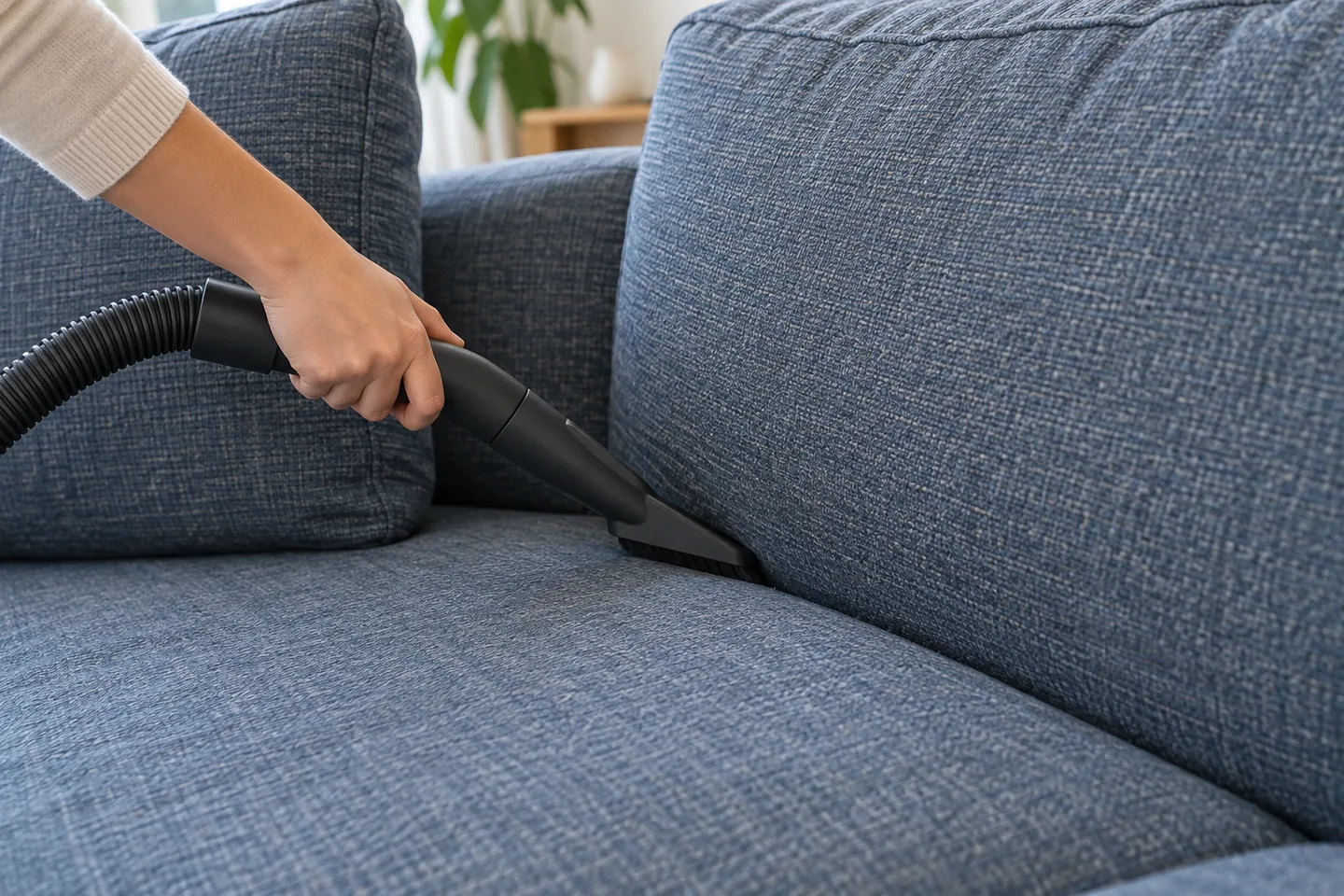
The following steps concern a sofa with no suspicious signs after the checks above. Their purpose is to remove ordinary, accessible dirt, not to treat an infestation or damage caused by damp. Read the care instructions first: even the attachment, suction setting and brushing must be suitable for a delicate fabric or velvet.
- Remove accessible objects and dry debris, followed by any parts the instructions allow you to move.
- Vacuum gently with a clean upholstery attachment suitable for the fabric. Reduce the suction if instructed, and avoid repeatedly working over a fragile seam or pulled thread.
- If a cover is explicitly removable and washable, follow all its instructions: programme, temperature, spin setting, permitted products and drying. A washable cover does not make the foam washable.
- For fixed upholstery, use only an authorised method. If spot treatment is allowed, follow the manufacturer’s conditions and requirement for an inconspicuous test; do not soak the seat.
- If instructions are missing or the fabric changes appearance, stop and have the situation assessed before continuing.
A smell alone cannot tell you the condition of the foam, and a fragrance does not provide a diagnosis. If an odour persists or a stain resists treatment, read the guide to that particular problem rather than adding more products. Cleaning may improve a compatible textile without removing every old mark or repairing wear.
- Understand a persistent sofa odour and the limits of treatment
- See the checks and stages involved in professional sofa cleaning
6. Allow for drying before sitting on the sofa
Prepare a ventilated space and keep the parts accessible while they dry. Follow the cover’s instructions when refitting it: some specify putting it back on while slightly damp, while others require a different procedure. In every case, wait until the sofa is completely dry before using it. The surface may seem dry while moisture remains in the inner layers.
Do not immediately cover the sofa with a throw or try to speed up drying with direct heat that the manufacturer has not authorised. There is no drying time that applies to every sofa: the material, amount of water, cushion thickness and ventilation all affect it. If damp persists or an unusual smell develops, seek advice before using the furniture again.

7. Does the total cost still make the purchase worthwhile?
Add up the sofa’s price, transport, any cleaning and the repairs it needs. A damaged cover, a sagging cushion or a structural part that needs replacing has a separate cost from textile care. Check that replacement parts are available before relying on them. Even a free sofa can involve more work than expected.
An estimate based on photographs can help you decide before collection, provided you show the defects and affected areas. It remains preliminary: the method, whether treatment is worthwhile and the possible result depend on examining the upholstery and its condition. Do not base your budget on a promise that every old stain will disappear.
8. Prepare the details for advice and a quote in Strasbourg
Pronett67 offers sofa cleaning at home in Strasbourg and the surrounding area, depending on the material and condition. For a second-hand sofa, say what you know and what you do not: acknowledging missing information is more useful than guessing. Do not add a product simply to improve the photograph before asking for advice.
- Number of seats or dimensions, brand, model and the label for the current upholstery, where available.
- Photographs of the whole sofa, seats, arms, seams, accessible underside and any areas of concern.
- Known history: storage, damp, stains, odours and treatments already applied.
- Location, access and the proposed schedule for transport and subsequent drying.
Advice before you decide
Plan the cleaning of your second-hand sofa
Send photographs of the sofa and its label, its dimensions and its known history for an initial estimate based on its condition.
Sources and care instructions to consult
The public sources explain when to pause before collecting furniture; manufacturers set out the limits for their own products. Their examples do not replace your sofa’s care instructions. The checklist above helps you prepare a decision, without certifying the frame’s condition or the absence of pests.
- US EPA: inspect second-hand furniture before bringing it home
- Stop Punaises: recognise signs that need specialist identification
- IKEA: care instructions for a specific MANNARP Gunnared cover
- Kvadrat Proof: fabric care and precautions for removable covers
- Ligne Roset: care booklets and recommendations for its upholstery
- US EPA: limits on salvaging wet and mouldy porous materials
What Pronett67 can do
Pronett67 — Strasbourg / Alsace. Sofa cleaning.
Frequently asked questions
Should you clean a second-hand sofa before using it?
Can you machine wash a sofa cover if it has a zip?
What should you do if the sofa care label is missing?
Does a smell mean a second-hand sofa cannot be salvaged?
Does professional cleaning guarantee a sofa is free from bed bugs?
Can you request a cleaning estimate before buying the sofa?
Related services
Related articles

Codes W, S, WS and X: how to read a sofa care label
Codes W, S, WS and X appear on many sofa labels, but they don't replace the manufacturer's instructions or a hidden-area test. Here is how to read them safely.
How to remove a persistent smell from a sofa
A persistent smell in a sofa is not fixed with a fragrance. Identify the source, air the room, remove debris, avoid risky mixtures — and treat the cause, not just the symptom.

How does professional sofa cleaning work?
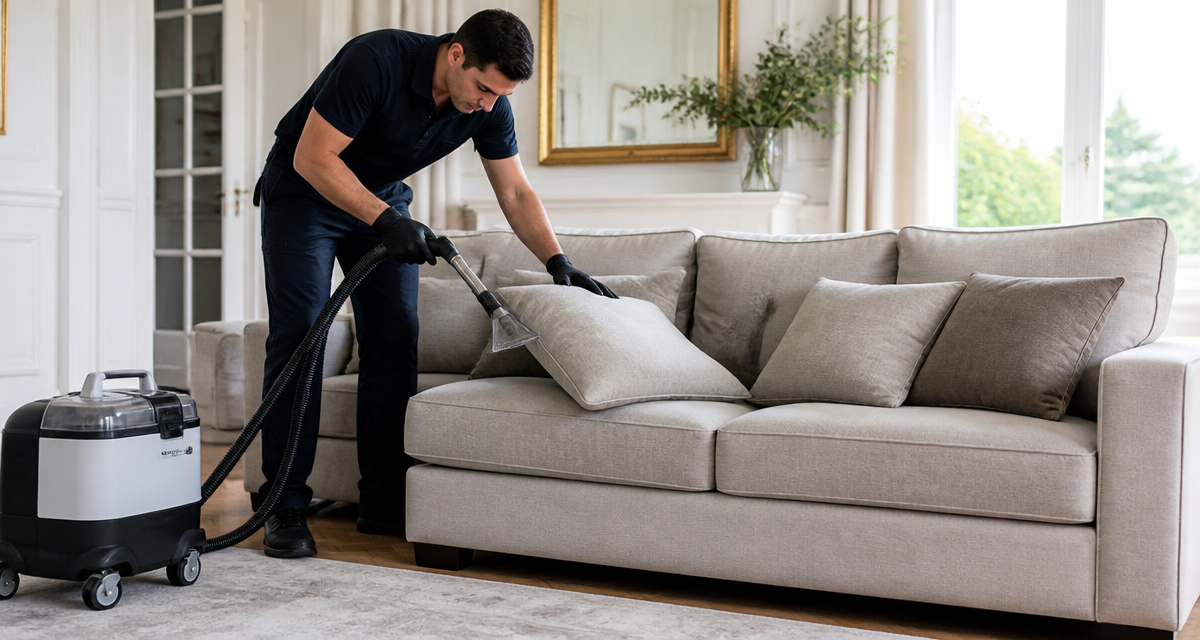
Inspection, vacuuming, pre-treatment, injection-extraction, drying: what a professional sofa cleaner actually does, without unrealistic promises.
Need professional cleaning in Strasbourg?
Send a photo of your sofa, mattress or rug for a first opinion and a clear estimate.